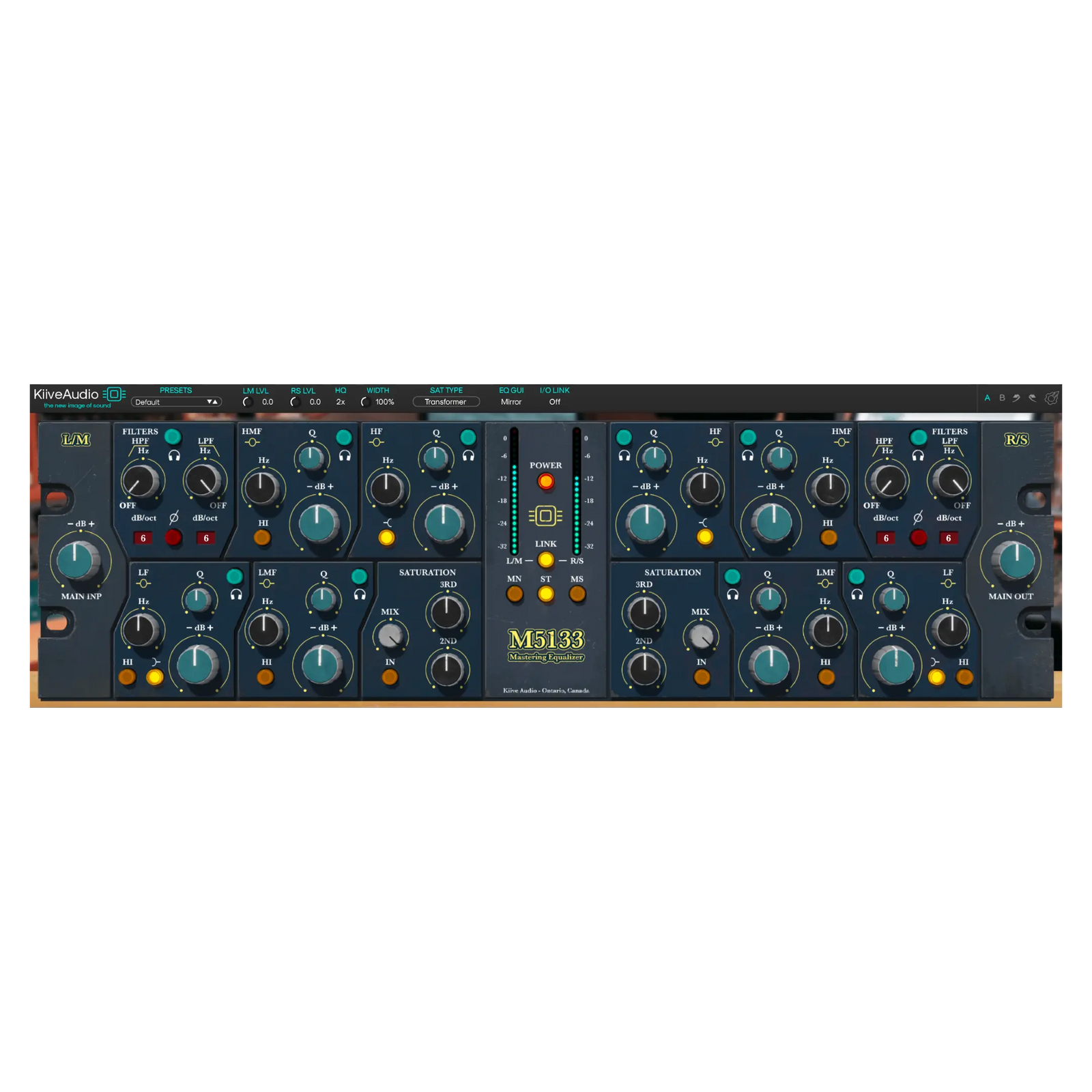

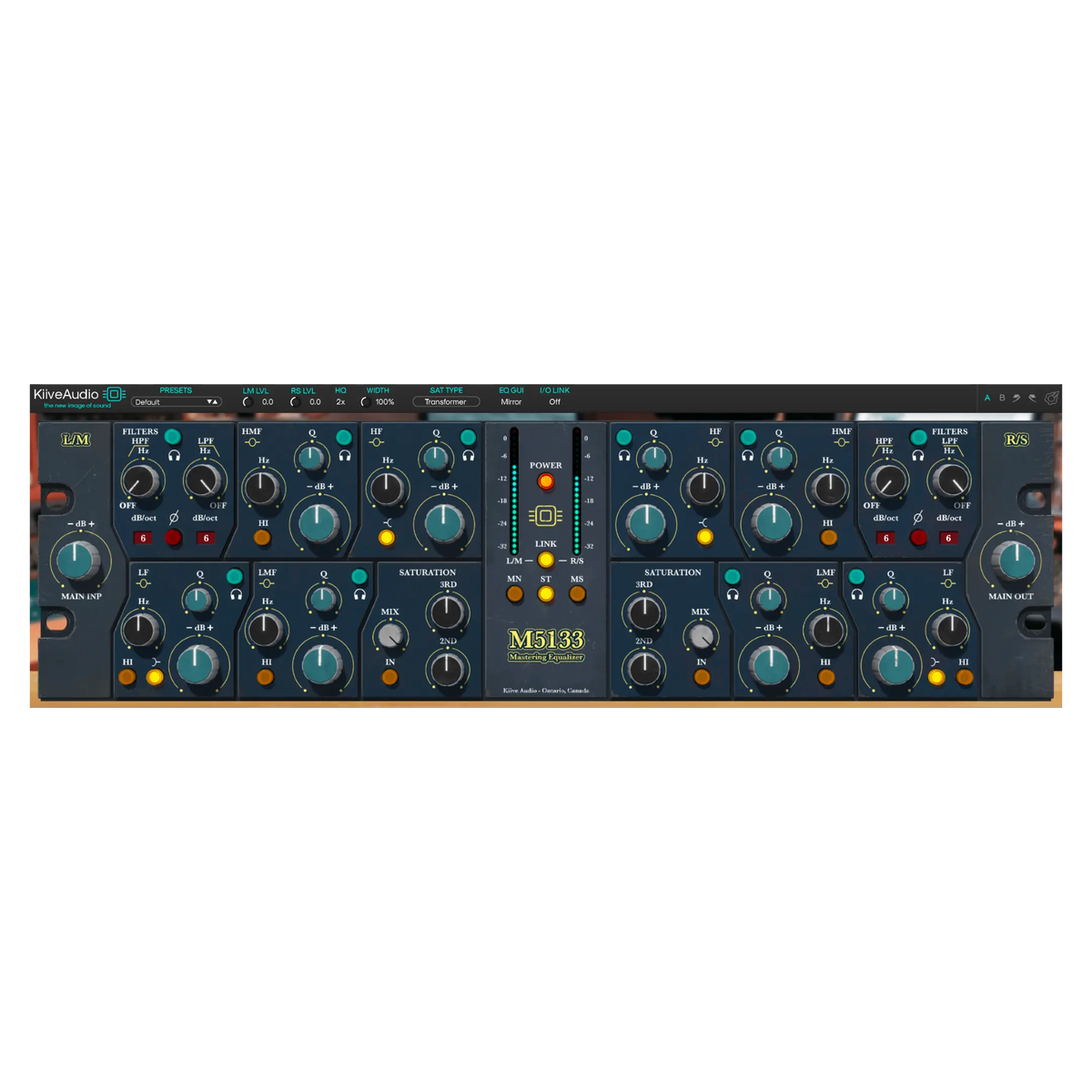
M5133 | Mastering Equalizer
The Mastering EQ You Finish Mixes With
4.9 (64)M5133 brings three generations of mastering EQ together with three saturation flavors for the final tone, balance, and color of your mix.
Hear M5133


Mastering EQ With Color Built In
Once the balance of your mix is right, the saturation section gives you another way to shape the final sound.
M5133 includes three saturation flavors with separate control over 2nd and 3rd order harmonics, so you can keep the color restrained or make it a bigger part of your final sound without adding another processor behind the EQ.
The EQ and saturation work together as one finishing stage instead of turning the end of your mix into another chain of plugins.

Three Generations In One EQ
M5133 takes the best features from three generations of a world-renowned mastering EQ and combines them in one design.
Instead of recreating a single revision, M5133 draws from all three and adds Kiive's own saturation section, giving you the musical response of a classic mastering EQ with more control over the final character.
M5133 Features

4 Variable EQ Bands with Per-Band Listen
Four fully variable EQ bands give you control over frequency, Q, and up to ±10 dB of gain, with switchable HI ranges that extend how far each band can reach.
The LF band can move from 20–160 Hz up to 100–770 Hz, the LMF from 39–270 Hz up to 180 Hz–1.2 kHz, and the HMF from 560 Hz–3.9 kHz up to 2.7–18 kHz. Use the "Hi" button to expand the range of each band.
Each band also includes Delta Solo, letting you isolate exactly what that band is adding or taking away before hearing it back in the full mix.

Musical High & Low Pass Filters
Dedicated high-pass and low-pass filters give you control over the very top and bottom of the mix, with variable cutoff frequency and selectable 6 dB/oct or 12 dB/oct slopes on both filters.
The gentler 6 dB/oct setting is especially useful when you want mastering-style cleanup without making the filter obvious, while 12 dB/oct gives you a steeper option when your mix needs tighter control.

3 Saturation Flavors
Choose between Transformer, Tape, and Tube saturation, then blend the result with the dedicated Mix control and shape it further with independent 2nd and 3rd order harmonic controls.
M5133’s EQ model also generates harmonics even when the dedicated saturation section is turned off, so the plugin retains its modeled character before you add any extra saturation at all.

2nd + 3rd Harmonic Control
M5133 lets you adjust 2nd and 3rd order harmonic content separately instead of giving you one fixed saturation response.
Set the balance between both harmonic types, then use the Mix control to blend the saturated signal with the dry signal and decide how much of that color becomes part of the final sound.

Oversampling, Stereo Control & Workflow
M5133’s top bar gives you quick access to the controls you’re most likely to reach for while mastering, including preset management, channel-level trims, stereo width, EQ GUI options, and I/O linking.
The HQ control lets you raise oversampling all the way to 16x when you want to reduce aliasing and increase processing quality, while the link controls let you work with the L/M and R/S channels linked or independently.
Frequently asked questions
Complete Your Signal Chain


NFuse | Bus Processor
NFuse combines two renowned mix-bus processors, letting you interchange saturation, EQ, compression, and stereo modules to build a bus chain neither can...


VX-Q
VX-Q pairs clean, musical EQ with five transformer saturation modes and Variance, moving from transparent correction to added weight, bite or texture.


M5133 | Mastering Equalizer
Finish Your Next Mix With M5133
Try M5133 free for 14 days on your own sessions before you buy.