

September 20, 2026
What Is FET Compression? How FET Compressors Shape Transients

A FET compressor uses a field-effect transistor as part of the gain-reduction stage. This design can support very fast attack behavior, which makes it useful for shaping drums, vocals, bass, room microphones, and parallel buses. FET does not mean one fixed speed or sound. The detector, timing range, ratio behavior, and the way the gain stage is driven still determine how the compressor reacts.
What is a FET compressor?
FET stands for field-effect transistor. In a documented classic compressor design, the FET works as a voltage-controlled resistive element that changes attenuation according to a control signal.
That mechanism can change gain quickly, but the FET is only one part of the compressor. The detector decides what triggers gain reduction. Attack and release shape the envelope. Ratio and knee affect how firmly the compressor responds. Input and output stages can add their own color.
The most accurate description is that FET gain control can support very fast behavior, not that every FET compressor is always fast.
How does FET compression work?
Audio passes through a gain-reduction stage that includes the FET. A detector follows the signal level and feeds a control circuit. Threshold, ratio, and knee determine the requested amount of gain reduction, while attack and release shape how that reduction develops and recovers.
FET compressors can use different detector layouts, feedback or feed-forward control, timing ranges, ratio behavior, and supporting amplifiers. Those choices are why the type does not guarantee one response.
Why can FET compression react so quickly?
A field-effect transistor can respond quickly to changes in the control signal. In a compressor designed around that ability, very short attack settings can reduce the first part of a transient before slower designs would apply the same amount of gain reduction.
The word can is essential. The available attack range depends on the individual compressor. One FET design may offer extremely short settings, while another may use a narrower or differently shaped range. The detector and timing circuit still determine when the FET receives the command to change gain.
Fast response is useful because it gives the engineer control over the first few moments of a sound. It is also easy to overdo. If the attack is too fast for the goal, a snare can lose its attack, a vocal consonant can pull backward, or a bass note can feel smaller even when the meter reading looks reasonable.
How attack changes a transient
Attack does not simply decide whether compression happens. It shapes how much of the initial event reaches the output before gain reduction builds.
On a snare or kick
A slower attack can let more of the first hit pass before the compressor pulls the body down. A faster attack can control that hit more firmly and bring the sustain or room forward relative to it. The result depends on ratio, threshold, knee, and how much gain reduction is applied, so attack cannot be judged in isolation.
On a vocal
Fast attack can catch sharp consonants and loud syllables, but it can also pull the vocal backward if the opening of every word is reduced too strongly. A slightly slower attack may preserve more articulation while still controlling the body of the phrase.
On bass
On bass, extremely fast compression can start reshaping the low-frequency waveform as well as the overall note envelope. Slower attack settings can leave more of the initial pick or pluck intact. Listen in the mix, because a bass sound that feels controlled in solo can lose definition beside the kick.
Release decides what happens next
Once the compressor has reduced a transient, release controls how it returns. On drums, a shorter release may let the room rise between hits and create obvious movement. A longer release may hold the bus more steadily but reduce contrast between the hit and decay.
On vocals, release can decide whether one loud word affects the next word or whether the compressor recovers in between. On bass, it can decide whether the gain reduction follows each note or stays engaged across a line.
The fastest attack is not automatically the most aggressive result. A fast attack with a long release can hold the signal down. A slower attack with a shorter release can leave the first hit intact and create more motion afterward. The envelope comes from the interaction between both controls.
What else changes how a FET compressor sounds?
Detector design
The detector decides what the compressor reacts to. A peak-oriented detector may respond strongly to short hits, while a detector that follows average energy more closely may respond to a broader part of the phrase. Sidechain filtering can reduce how much low end drives that decision.
Feedback or feed-forward control
In a feed-forward design, the detector reads the signal before gain reduction. In a feedback design, it reads the output. That changes the relationship between the incoming signal and the control action. It does not create a simple quality ranking.
Ratio and knee behavior
Ratio helps determine how strongly the compressor reduces level above threshold. Knee shapes the transition into that compression. Some FET designs use switched ratios, and the response may change in more ways than the number alone suggests.
Input level and nonlinear stages
Driving the input harder can create more gain reduction and may change the color of the gain stage or supporting amplifiers. If the compressor includes optional harmonic or saturation controls, compare them separately from the timing so you know whether you are hearing envelope change, tonal change, or both.
Where is FET compression useful?
- Drums and percussion: Fast timing can reshape the first hit, while release can bring room and sustain forward.
- Room microphones: Heavier gain reduction can turn room decay into part of the groove.
- Vocals: A suitable attack and release can control sharp syllables while keeping the phrase present.
- Bass: FET compression can control peaks and add density when the timing preserves the note shape you need.
- Parallel compression: Heavy compression can be blended under the dry signal to add sustain and movement without replacing the original transient.
- Buses and stems: FET is not limited to individual channels. The right design can work on drums, instruments, or a full mix when the envelope supports the song.
FET vs VCA vs optical compression
Gain-control method: Field-effect transistor in the gain-reduction stage.
Useful starting point: Fast transient shaping, drums, vocals, rooms, and parallel compression.
Important caveat: Does not define one attack speed.
Gain-control method: Voltage-controlled amplifier or equivalent gain cell.
Useful starting point: Precise control, bus compression, stereo linking, and sidechain shaping.
Important caveat: Does not automatically mean clean.
Gain-control method: Light source and light-sensitive element.
Useful starting point: Program-dependent leveling on vocals, bass, and acoustic instruments.
Important caveat: Does not automatically mean slow.
The table gives you a starting point, not a rule. The individual compressor and settings determine the result.
Try FET compression on a drum bus
Use a section with kick, snare, cymbals, and some room sound.
- Start with a moderate ratio and set threshold for a clear but not extreme amount of gain reduction.
- Match the output level to bypass.
- Set the release long enough that the compressor remains engaged between some hits.
- Move the attack from slower to faster and listen to the snare attack, not only the meter.
- Adjust release and listen to whether the room rises between hits or stays held down.
- Reduce the threshold for heavier compression, then blend the dry signal back in if the design includes a mix control.
- Return to a musically realistic setting before deciding whether the compressor belongs on the bus.
This comparison makes the timing audible without pretending that one attack or release value works for every drum recording.
Common misconceptions
Misconception: FET compressors are always fast.
Correction: FET gain control can support very short attack times, but the available range and envelope depend on the individual design.
Misconception: Faster attack always means more punch.
Correction: A faster attack can reduce the first transient. Depending on the release and amount of gain reduction, that may bring sustain forward or make the hit feel smaller.
Misconception: FET compression is only aggressive.
Correction: FET compressors can be used subtly or heavily. Timing, ratio, threshold, detector behavior, and gain staging determine how audible the result becomes.
Frequently asked questions
What does FET mean in a compressor?
It means a field-effect transistor forms part of the gain-reduction stage. A detector and control circuit determine how that stage changes level.
Are FET compressors always fast?
No. The gain-control method can support very fast behavior, but the available attack range and the shape of the response depend on the individual compressor.
Is FET compression good for drums?
It can be. FET timing can reshape the first hit and the sustain behind it, which is useful on close drums, room microphones, drum buses, and parallel compression.
What does fast attack do to a transient?
It builds gain reduction earlier in the event, which can reduce more of the initial hit. Whether that sounds tighter, smaller, denser, or more controlled depends on release, ratio, threshold, and the amount of gain reduction.
Can a FET compressor work on vocals?
Yes. It can control sharp consonants and loud syllables, but attack and release should be set so the vocal keeps the articulation and movement the song needs.
Related Kiive Learn guides
Explore Kiive Plugins
Want to apply what you learned in your own mixes? Every Kiive plugin includes a fully functional 14-day trial with no card required.
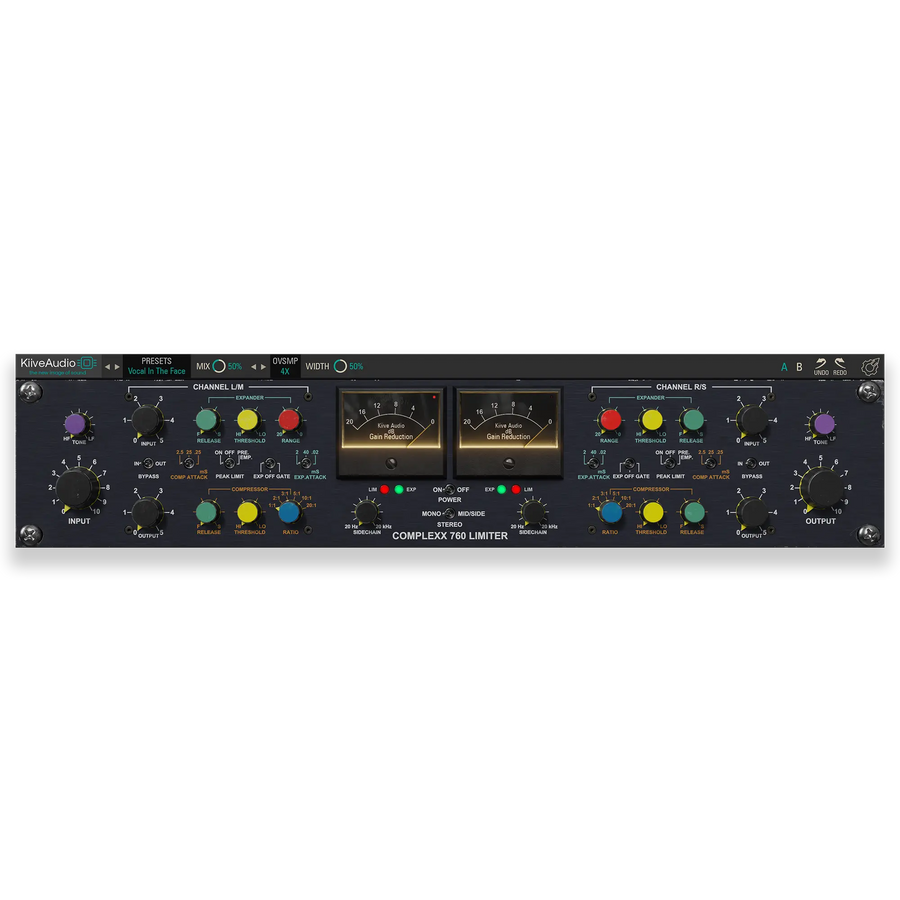
Complexx
FET compression with flexible attack and release control, sidechain filtering, parallel blend, expansion, and limiting.