
September 25, 2026
Inductor EQ vs Parametric EQ: What's Different?

An inductor EQ and a parametric EQ are not true opposites. "Inductor" tells you that an EQ uses an inductor somewhere in its frequency-shaping circuit. "Parametric" tells you how much control you have over a band, usually independent control of frequency, gain, and Q or bandwidth.
The useful comparison is therefore not component versus component. It is the workflow of many classic inductor-based EQs versus the open-ended control of a fully parametric EQ.
What does parametric EQ mean?
A fully parametric band normally lets you adjust three things:
- Frequency: the center of the area you want to affect
- Gain: how much you boost or cut
- Q or bandwidth: how wide or narrow the move is
That independence is what makes a parametric EQ flexible. You can use a narrow cut to reduce a resonance, a wide bell to rebalance a vocal, or several overlapping bands to reshape a difficult source.
Parametric does not mean digital. Analog consoles and outboard units can use parametric bands, while digital EQs can deliberately imitate fixed-frequency or proportional-Q behavior.
What does inductor EQ mean?
An inductor EQ uses one or more inductors in its filter network. The term describes a circuit component, not a control format: the design may use stepped or sweepable frequencies, fixed, selectable, or proportional Q, shelves, bells, or a combination of them.
If you want the circuit explanation first, read What Is an Inductor EQ?.
Can an inductor EQ be parametric?
Yes. A designer can build an EQ band around an inductor-based network and still provide variable frequency, gain, and bandwidth controls. The categories overlap because they describe different layers of the design.
This distinction prevents several common mistakes. Inductor does not mean passive, parametric does not mean clean, and neither term tells you whether the processor is analog or digital.
Why do many inductor EQs feel different to use?
Many familiar inductor-based equalizers were designed around a smaller set of selected frequency points. Instead of offering every possible center frequency and bandwidth, they guide you toward a few curves that were chosen to work well on common recording and mixing problems.
That can change how you listen. With a fully parametric EQ, you may sweep until you find an exact resonance and then decide how tightly to cut it. With a stepped EQ, you are more likely to choose the nearest useful band, make a broad move, and judge the result in the mix.
The faster workflow is not an inherent property of inductors. It comes from the complete control design. A fixed-frequency EQ without inductors can be just as immediate, and an inductor-based EQ can be made highly adjustable.
Broad shaping vs surgical correction
Broad curves are useful when the problem is tonal. A vocal may need more upper-mid presence across a wide range, or a mix may need a little more low-frequency weight without emphasizing one narrow note.
A narrow parametric band is useful when the problem is specific. You may need to reduce a ringing snare overtone, a whistle in a guitar cabinet, or a room resonance that lives in a small frequency range.
Both tools can cross into the other's territory. A parametric EQ set to low Q can make a broad tonal move. An inductor-based design can include focused curves or variable bandwidth. The right question is whether the available curve and controls suit the job in front of you.
Fixed frequencies vs continuous frequency control
Fixed or stepped frequency choices can seem restrictive, but the limitation can be useful. It keeps you listening to the result instead of chasing tiny numerical differences.
Continuous control gives you more precision. It is valuable when a problematic frequency sits between the available steps, when several sources need different treatment, or when a filter must follow a very specific resonance.
Neither workflow is universally faster. Stepped choices can speed up tonal shaping, while a continuous parametric band can solve a narrow problem in one move that a fixed-frequency EQ cannot reach.
How does Q differ?
A parametric EQ normally gives you direct control over Q. Low Q affects a wider frequency range. High Q concentrates the move more tightly around the center frequency.
Many classic-style EQs use a fixed or design-dependent Q instead. Some use proportional Q, where the curve becomes narrower as you increase the amount of boost or cut. Others offer a few bandwidth choices rather than a continuously variable control.
Those behaviors are not exclusive to inductor circuits. They are choices made by the designer. For a closer look at gain-dependent bandwidth, read Proportional Q Explained.
What about circuit color?
An inductor-based analog EQ may include real inductors, transformers, discrete amplifier stages, or other components that become nonlinear under some conditions. A modeled plugin may reproduce some or all of that behavior. A parametric EQ may also contain or model nonlinear circuitry.
Do not assume that every inductor EQ is colored or every parametric EQ is transparent. Check the specific design, then decide whether you want its circuit behavior in addition to its curve.
Which EQ should you use?
Use a fully parametric EQ when you need exact frequency placement, independent bandwidth control, or several bands working on unrelated problems. It is especially useful for resonances, corrective cuts, room problems, and detailed source cleanup.
Use a more constrained, classic-style EQ when you want to make broad tonal decisions quickly and the available frequency points already fit the source. This can work well for shaping drums, vocals, bass, guitars, buses, and masters without turning every move into a search for the most exact number.
In practice, many sessions benefit from both. A parametric EQ can solve a narrow problem first, followed by a broader EQ for weight, presence, or overall balance.
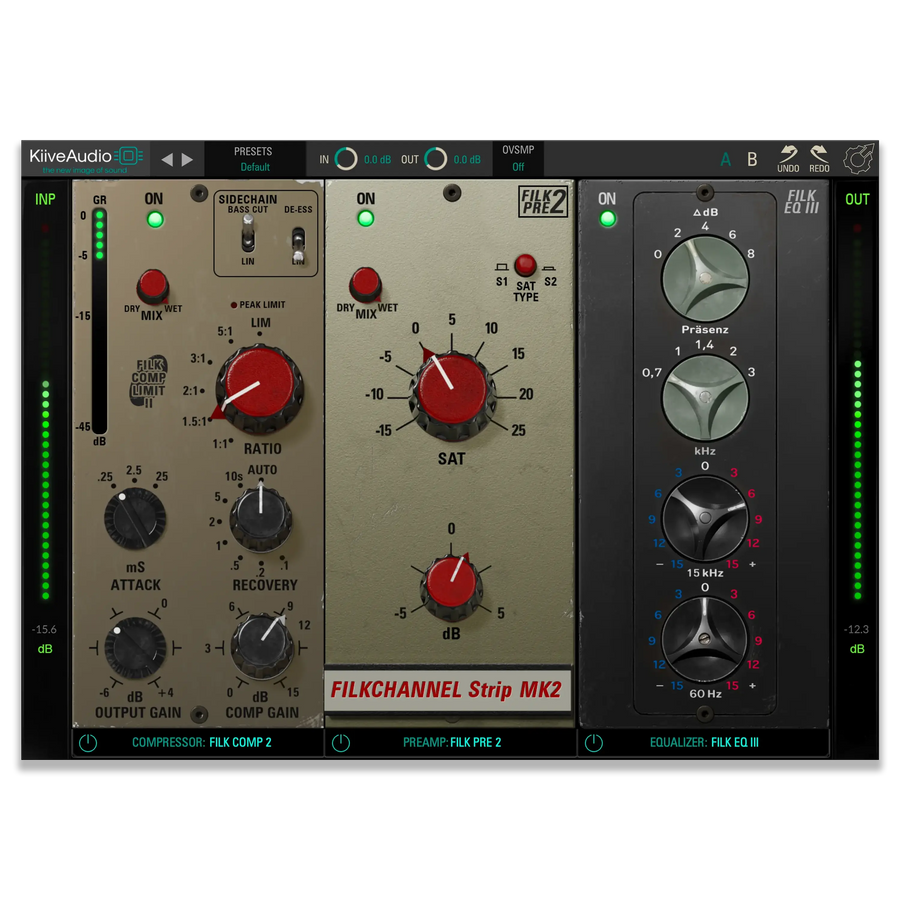
Filkchannel MK2 demonstrates both approaches in one plugin: EQ I is parametric, while EQ II includes an inductor-based midrange. Explore Filkchannel MK2 or compare the current Kiive EQ collection.
Inductor EQ vs parametric EQ at a glance
Frequency choices: Often stepped or semi-fixed.
Bandwidth: May be fixed, selectable, or proportional.
Strength: Fast broad tonal decisions.
Limitation: May not reach an exact problem frequency.
Frequency choices: Continuously variable.
Bandwidth: Independently adjustable.
Strength: Precise correction and flexible shaping.
Limitation: More choices can slow a simple tonal decision.
These are common workflows, not definitions. Specific EQs can combine parts of both.
Frequently asked questions
Is an inductor EQ the same as an analog EQ?
No. Many analog EQs do not use inductors, and software can model an inductor-based circuit. Analog describes the implementation domain, while inductor describes a component used in the design.
Can an inductor EQ be parametric?
Yes. An inductor-based band can still provide variable frequency, gain, and Q controls.
Are parametric EQs always clean?
No. A parametric EQ can include or model transformers, amplifiers, saturation, or other nonlinear stages. Its control format does not guarantee transparency.
When should I use a parametric EQ instead?
Use one when you need to reach an exact frequency, set a precise bandwidth, or make several independent corrective moves.
Related Kiive Learn guides
Explore Kiive Plugins
Want to apply what you learned in your own mixes? Every Kiive plugin includes a fully functional 14-day trial with no card required.