
September 25, 2026
What Is an Inductor EQ? How Inductor Equalizers Work

An inductor EQ uses one or more inductors as part of the circuit that shapes frequency response. The inductor does not define the entire equalizer, and it does not guarantee one specific sound. It gives the designer a frequency-dependent component that can work with capacitors and resistors to create shelves, bell curves, filters, and resonant responses.
That is the useful starting point. An inductor is part of the filter network, while the complete sound and control behavior come from the whole design around it.
What is an inductor?
An inductor is usually a coil of conductive wire, often wound around a magnetic core. When current flows through the coil, it creates a magnetic field and stores energy in that field.
For audio work, the important detail is that an inductor does not oppose every frequency by the same amount. Its reactance increases as frequency rises. In simple terms, a given inductor presents less opposition to low frequencies and more opposition to high frequencies.
A capacitor behaves in the opposite general direction: its reactance decreases as frequency rises. Put inductors and capacitors into a network with resistors, and the circuit can favor, reduce, or resonate around different frequency ranges.
How does an inductor shape an EQ curve?
An EQ circuit routes different frequencies through a network whose impedance changes across the spectrum. Because an inductor's reactance rises with frequency, its relationship with the surrounding capacitors and resistors can establish a turnover point, center frequency, bandwidth, and curve shape.
Depending on the design, the controls may select different inductor taps, capacitor values, resistance values, or other parts of the filter network. Those choices determine what happens when you select one frequency instead of another, or when a low band changes from a shelf to a bell.
This is why two inductor EQs can feel very different. One may offer a few stepped frequencies and broad curves. Another may include more bands, a variable frequency control, selectable shelves, or proportional-Q behavior. The presence of an inductor tells you something about the filter network, but it does not tell you the entire control layout.
Is "inductor EQ" one circuit type?
No. The term is useful shorthand for an equalizer that uses inductors in part of its frequency-shaping network. It is not one universal topology.
An inductor EQ can also contain:
- capacitors and resistors in the filter network
- transformers at the input, output, or between stages
- discrete transistor or op-amp gain stages
- active buffers and line drivers
- switches, relays, or digitally controlled analog components
- saturation or output circuitry that is separate from the EQ network
An inductor may sit inside a passive filter network, an active EQ design, or a circuit that combines passive frequency shaping with active gain stages. The EQ may use fixed frequency selections or variable controls, and it may stay clean or become more nonlinear when driven. Those traits depend on the complete design.
Why are inductor EQs often associated with broad curves?
Many well-known inductor-based equalizers were built around a limited set of carefully chosen frequency points. Their bands often use relatively broad curves, and some designs let the bandwidth change with the amount of boost or cut.
That workflow can make large tonal decisions feel quick. Instead of sweeping a narrow bell across every frequency, you choose a useful range and decide whether the source needs more weight, less boxiness, or a clearer upper midrange.
The broad behavior is not caused by the inductor alone. It comes from the selected component values, circuit arrangement, available frequency points, and Q behavior. A designer can use inductors in a more focused circuit, just as a parametric EQ can be set to a very wide curve.
Do inductors add saturation or harmonics?
An ideal inductor is a linear component. A real magnetic-core inductor can become nonlinear when its core is driven toward saturation, and its losses and behavior can vary with level and frequency. That does not mean every inductor EQ adds obvious harmonics or that inductors automatically make an EQ sound warm.
What you hear may also come from the amplifier stages, transformers, operating level, component tolerances, source and load impedances, or deliberate saturation elsewhere in the circuit. In some designs, those elements are a major part of the result. In others, the EQ may stay comparatively restrained unless it is pushed.
The inductor helps create the frequency-selective network. The sound you associate with the EQ comes from that network and the rest of the circuit working together.
How does an inductor EQ feel in a session?
The typical experience is less about drawing an exact curve and more about choosing among a set of useful tonal moves. That can be helpful when you know the musical direction but do not need to isolate a resonance to the nearest hertz.
You might reach for this kind of workflow when:
- a vocal needs more forward midrange without a narrow, obvious peak
- a bass needs weight over a broad low-frequency area
- drums need presence or thump without turning the EQ into a repair job
- a bus needs a small tonal shift that affects several related frequencies together
- you want to make a decision quickly from a few purposeful frequency choices
None of those jobs requires an inductor. A fully parametric EQ can make broad moves too. The appeal is often the combination of curve design, limited choices, and circuit behavior in one tool.
Inductor EQ vs parametric EQ
These terms describe different things. "Inductor" refers to a component and circuit approach. "Parametric" describes an EQ band whose frequency, gain, and Q or bandwidth can be adjusted independently.
An EQ can therefore use inductors and still offer parametric or semi-parametric controls. Many classic inductor-based designs use stepped frequencies and limited Q options, but that is a design choice rather than a definition.
For a practical comparison of the workflows, read Inductor EQ vs Parametric EQ: What's Different?.
A current Kiive example
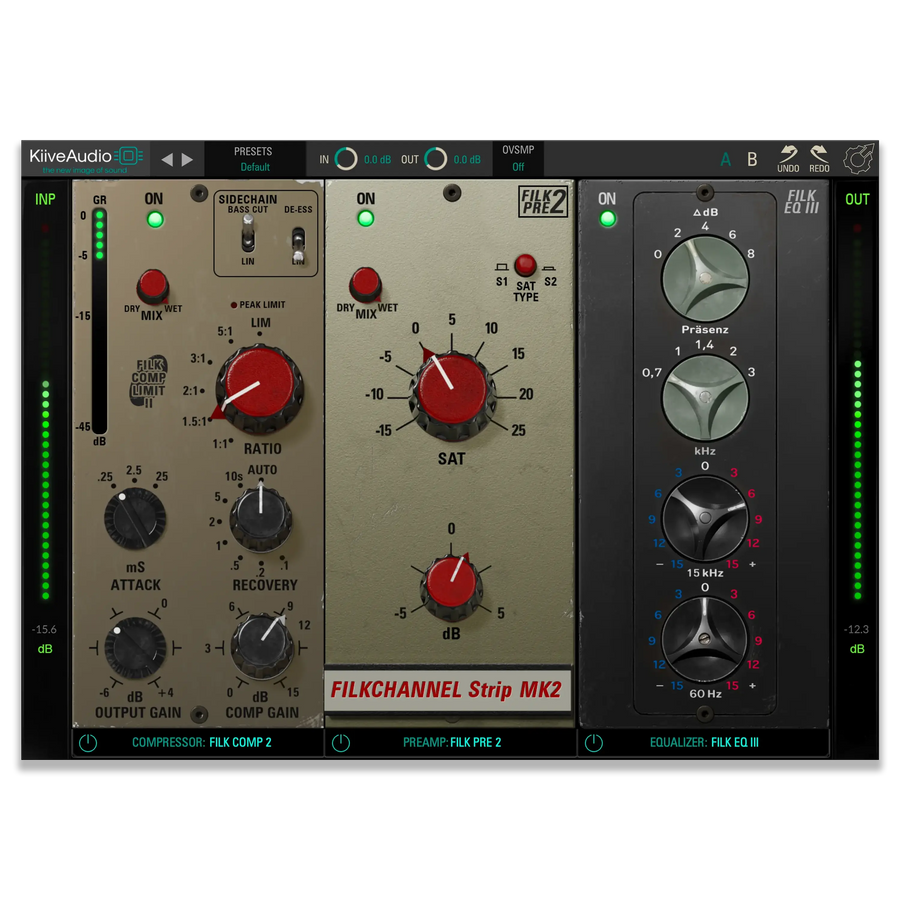
Filkchannel MK2 makes the distinction easy to hear because its current design includes several different EQ sections. EQ I is a three-band parametric EQ, while EQ II includes an inductor-based midrange along with input and output transformers. The point is not that one is better. They give you different controls and different ways to arrive at a useful curve inside the same channel strip.
You can explore Filkchannel MK2 or browse the current Kiive EQ collection if you want to compare those workflows in a session.
Common misconceptions
Misconception: An inductor EQ is always passive.
Correction: An inductor can appear in a passive filter network, but the complete equalizer may include active gain stages, buffers, transformers, or other powered circuitry.
Misconception: Inductors automatically add warm harmonics.
Correction: Magnetic-core inductors can behave nonlinearly under some conditions, but the audible result depends on the component, level, loading, and surrounding circuit.
Misconception: Every inductor EQ has broad fixed-frequency bands.
Correction: Many familiar designs use that workflow, but inductors can be used in circuits with different frequency and Q controls.
Misconception: Inductor EQ and parametric EQ are opposites.
Correction: One term describes part of the circuit. The other describes the controls available to the user.
Frequently asked questions
What does an inductor do in an EQ?
Its opposition to alternating current changes with frequency. Combined with capacitors and resistors, that behavior helps form filters and EQ curves.
Are all inductor EQs passive?
No. The filter network may be passive or active, and the complete device can contain powered amplifier stages, buffers, transformers, and other circuitry.
Do inductors add saturation?
A real magnetic-core inductor can become nonlinear when driven, but saturation is not guaranteed and should not be treated as the defining sound of every inductor EQ.
What is the difference between an inductor and a capacitor in an EQ?
Both are frequency-dependent components. Inductive reactance rises with frequency, while capacitive reactance falls. Designers combine them with resistance to create the desired filter response.
Related Kiive Learn guides
Explore Kiive Plugins
Want to apply what you learned in your own mixes? Every Kiive plugin includes a fully functional 14-day trial with no card required.