

September 20, 2026
What Is Vari-Mu Compression? How Variable-Mu Compressors Work

A vari-mu compressor controls gain by changing the operating conditions of a tube stage. The resulting transfer curve can change with signal level, so ratio, knee, timing, and coloration may develop together rather than behaving like completely separate controls. Vari-mu does not automatically mean slow, gentle, or restricted to mastering.
What is vari-mu compression?
Vari-mu is short for variable-mu. Mu is a tube-amplification term. In a vari-mu compressor, the control signal changes the operating point of a suitable tube stage so its gain changes with the program.
The tube is the gain-control element, but it is not the whole compressor. Detector placement, control voltage, time constants, operating level, tube choice, supporting amplifiers, and transformers where present all shape the result.
How does a vari-mu compressor work?
Audio passes through a tube gain stage. A detector and control circuit create a control voltage from the program. That voltage changes the tube stage's operating conditions, which changes its gain.
In many vari-mu designs, the effective ratio increases as the signal drives farther into compression. The transition into gain reduction may therefore form a broad knee rather than one fixed corner. This behavior depends on the tube circuit and the way ratio and timing are designed, not on the words variable-mu alone.
Operating level matters
The level reaching the tube stage affects how far the compressor moves along its transfer curve. Raising input level may produce more gain reduction, a different effective ratio, and more nonlinear coloration at the same time. That is why input drive can feel like part threshold control and part tone control in some designs.
Knee and ratio may develop with level
A conventional ratio label describes the relationship between input and output above a threshold. In a vari-mu circuit, the slope may change as the control voltage changes the tube's gain. A single ratio number may therefore describe only part of the behavior.
Timing can be program-dependent
The detector and time-constant network determine how quickly the control voltage builds and recovers. Some designs use multi-stage or automatic release behavior so a short peak and a sustained passage do not recover identically. That response is an implementation choice, not a guaranteed trait of every vari-mu compressor.
Tubes and transformers are separate variables
The gain-control tube can introduce nonlinear behavior, and other tubes or transformers in the signal path can contribute additional level-dependent color. A vari-mu compressor without the same supporting circuit will not necessarily have the same frequency response, distortion, headroom, or transient behavior.
What does vari-mu compression change in audio?
Vari-mu compression can change the relationship between short peaks, sustained energy, and overall density. On a vocal, the compressor may move differently on a short consonant than on a held note. On bass, input level and release can determine whether each note recovers independently or the whole line stays under gain reduction. On a bus, the detector and time constants can make multiple instruments share one broader movement.
The tonal result can change with drive as well. When the tube or transformer stages enter more nonlinear regions, the processing may add harmonics or change density in addition to controlling level. Do not attribute every tonal change to the vari-mu control action itself.
Vari-mu vs optical and VCA compression
Gain control: A tube stage changes gain as its operating conditions change.
Design consideration: Operating level, control voltage, tube circuit, time constants, and transformers where present can interact.
Do not assume: Every vari-mu is slow, gentle, or mastering-only.
Gain control: A light source and light-sensitive element change attenuation.
Design consideration: Illumination history and the optical element can shape program-dependent timing.
Do not assume: Every opto has the same attack or recovery.
Gain control: A voltage-controlled amplifier or equivalent gain cell changes level.
Design consideration: Ratio and knee behavior, detector, timing, and nonlinear stages can vary widely.
Do not assume: VCA identifies a fixed sound.
These are design approaches, not rankings. The individual implementation and settings decide which compressor fits a given job.
When is vari-mu compression useful?
Vari-mu compression is useful when its transfer curve, timing, and signal path support the musical movement you want. Mix buses and mastering chains are common applications, but they are not the only ones. Vocals, bass, room microphones, piano, strings, and stems can all benefit from the right design and settings.
On a mix bus, listen to whether loud sections become more stable without losing the contrast between the kick, snare, and vocal. On bass, listen for recovery between notes. On a vocal, compare how short syllables and held vowels affect the gain-reduction envelope.
If the design offers a compression bypass that preserves its tube and transformer path, use that mode to separate tonal change from gain reduction. This is a feature of particular compressors, not a universal vari-mu function.
Try this vari-mu listening test
Use a vocal, bass line, or mix section that contains both short peaks and sustained energy.
- Set the compressor for audible gain reduction and match the output to bypass.
- Compare a short peak with a held note at a similar peak level.
- Raise and lower the input level while compensating the output. Listen for changes in both gain movement and tone.
- Compare the available time-constant or release modes across the whole phrase.
- If the design has a compression bypass that retains the tube path, compare bypassed color with gain reduction engaged.
- Return to a practical amount of processing and judge the result in the mix.
This separates three questions: how the compressor controls level, how it recovers, and what the surrounding circuit adds.
Common misconceptions
Misconception: Vari-mu compression is always gentle.
Correction: The result depends on operating level, control signal, tube circuit, timing, and how much gain reduction is requested. A vari-mu design can be subtle or clearly audible.
Misconception: Vari-mu compressors are only for mastering.
Correction: They are also used on vocals, bass, instruments, stems, and buses. Mastering is an application, not a definition.
Misconception: Vari-mu compressors are always slow.
Correction: Timing comes from the detector and time-constant network. Some modes can respond faster than the stereotype suggests.
Misconception: Tubes automatically add warmth.
Correction: Tube stages can produce level-dependent nonlinear behavior, but the audible result depends on the tube, circuit, operating level, transformers, and frequency response.
Misconception: All vari-mu compressors sound alike.
Correction: Tube choice, overall design, detector, ratio and knee behavior, time constants, transformers, and headroom can vary substantially.
Frequently asked questions
What does vari-mu mean?
It means a tube stage changes gain as a control signal changes its operating conditions. The exact transfer curve and timing depend on the individual circuit.
Is vari-mu compression always slow?
No. Some designs use longer or program-dependent timing, but the detector and time constants establish the available response. Vari-mu does not specify one attack or release speed.
Why does input level matter so much on a vari-mu compressor?
Input level affects how far the tube stage is driven into its changing gain curve. More drive can change gain reduction, effective ratio, knee behavior, and nonlinear color together.
Can vari-mu compression work on vocals or bass?
Yes. It can be useful whenever its envelope and tone suit the phrase. Listen to articulation, sustain, recovery between notes, and any tonal change caused by the signal path.
Can a vari-mu compressor add color without compressing?
Only if the individual design provides a mode that bypasses gain reduction while retaining its tube or transformer path. That is not a universal vari-mu feature.
Related Kiive Learn guides
Explore Kiive Plugins
Want to apply what you learned in your own mixes? Every Kiive plugin includes a fully functional 14-day trial with no card required.
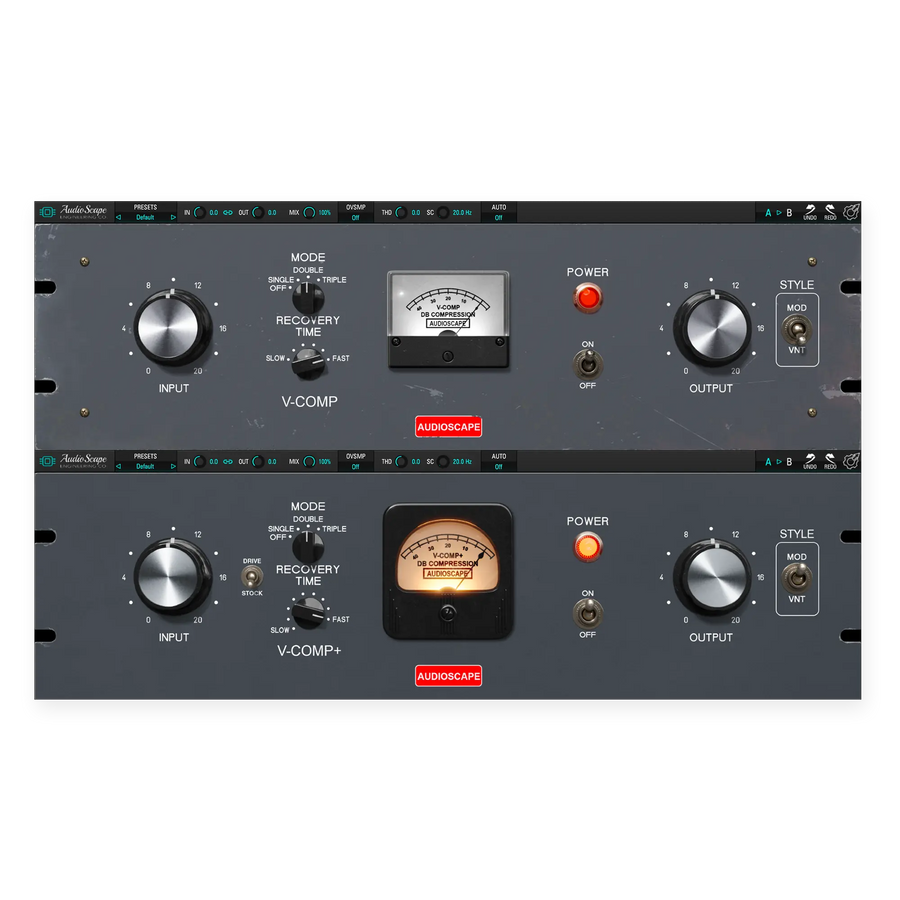
V-Comp | AudioScape
Seven-tube vari-mu compression with selectable time-constant modes and a bypass mode that retains the documented tube and transformer path.