
September 26, 2026
Soft Clipping vs Saturation vs Limiting: What Happens to Your Peaks?

Soft clipping bends waveform peaks through a nonlinear transfer curve, saturation is a broader family of level-dependent nonlinear behaviors, and limiting uses controlled gain reduction to contain peaks. All three can reduce peak level, but they do not reach that result through the same mechanism or create the same side effects.
The practical choice starts with the job. Use soft clipping when intentional peak shaping and harmonics are welcome, saturation when tone and density are part of the goal, and limiting when the main need is controlled peak level.
What is soft clipping?
Soft clipping is nonlinear waveform shaping in which the input-to-output curve bends gradually as the signal approaches a threshold. Instead of reproducing each additional volt or sample proportionally, the processor gives the loudest parts progressively less output. Peaks become rounded rather than being cut off at one abrupt ceiling.
That curved transfer creates harmonic distortion. The harmonic pattern depends on the shape and symmetry of the curve, the input waveform, and how far the signal is driven. Soft clipping does not guarantee even harmonics, warmth, or transparency.
A basic soft clipper does not need a separate level detector, attack time, or release time. Its output follows the instantaneous transfer curve. Some plugin designs add oversampling, filtering, or other controls, but those features do not turn clipping into ordinary detector-based dynamics processing.
Soft clipping is useful when a snare, kick, bass transient, or mix peak can lose a small amount of crest height while gaining intentional harmonic character. Push it too far and the same process can flatten attacks, crowd the midrange, or make cymbals abrasive.
Is saturation the same as clipping?
Saturation is a broader term for nonlinear behavior that increases as a system is driven. It can include soft-clipping-like compression of peaks, but a real or modeled tape path, transformer, tube stage, transistor circuit, or magnetic core can also add frequency-dependent distortion, hysteresis, memory effects, changing impedance, and level-dependent frequency response.
That is why tape, transformer, and tube saturation should not be treated as different labels for one generic curve. Two processors can show similarly rounded peaks and still sound different because their harmonics, bandwidth, recovery behavior, and frequency dependence are different.
Saturation may reduce crest factor, but peak control is not always its primary purpose. An engineer may choose it for density, weight, brightness, softness, or a change in how elements sit together. Those descriptions are outcomes to listen for, not guaranteed properties of every saturation stage.
For a closer look at magnetic systems, read Tape Saturation vs Transformer Saturation: What's the Difference?.
What is limiting?
Conventional limiting is dynamic gain reduction used to keep signal peaks under control. A detector measures level, and a gain-control element turns the signal down when the level crosses or approaches the operating threshold.
Attack and release determine how quickly many conventional limiters reduce and restore gain. Digital limiters may also use lookahead so gain reduction can begin before an upcoming peak reaches the output. Analog designs may use different detectors, time constants, and control elements, but the defining idea in conventional limiting is active gain reduction rather than a fixed nonlinear transfer curve alone.
A limiter can remain comparatively clean when it only catches occasional peaks. It can also create distortion, pumping, or transient loss when driven hard or released too quickly. That distortion does not make limiting the same mechanism as saturation.
Some hardware and plugins combine limiting with an intentionally colored amplifier or output stage. In those cases, the dynamic control and nonlinear color can both be active at once. It is still useful to understand which section is doing which job.
Soft clipping, saturation, and limiting compared
| Process | Main mechanism | Primary job | Common side effects |
|---|---|---|---|
| Soft clipping | Gradually curved nonlinear transfer near a threshold | Reduce and reshape peaks | Harmonics, rounded transients, reduced crest factor |
| Saturation | Level-dependent nonlinearity in a physical or modeled system | Add color, density, or nonlinear shaping | Harmonics, frequency-dependent tone, peak softening, possible memory effects |
| Limiting | Detector-controlled gain reduction in conventional designs | Contain peak level and dynamics | Gain modulation, transient change, pumping or distortion when pushed |
These categories can overlap inside one processor. A saturated amplifier can sit before a limiter, a clipper can feed detector-based gain control, and a limiter's output stage can add its own color. The signal path matters.
Is soft clipping compression?
Soft clipping compresses the amplitude of the waveform near its peaks in the broad mathematical sense, but it is not the same as a conventional compressor with a detector and attack/release timing.
That distinction is audible. A clipper changes the waveform at the peak itself. A compressor or limiter can begin reducing gain around the event and continue doing so after the peak, depending on its timing. The clipper may shave a few short transients without moving the body of the sound, while a limiter may reshape the envelope over a longer window.
When should you use each process?
Use soft clipping when the tallest peaks can be shortened and a little intentional harmonic shaping supports the sound. It can be effective on drums, bass, aggressive vocals, or a mix with isolated transient spikes.
Use saturation when the desired change includes tone, density, or level-dependent texture. The best placement may be earlier in the chain, where the nonlinear stage can shape the signal before later EQ or dynamics decisions.
Use limiting when output containment is the priority. That may mean catching overs on a recording path, controlling a bus, or setting the final peak ceiling during mastering.
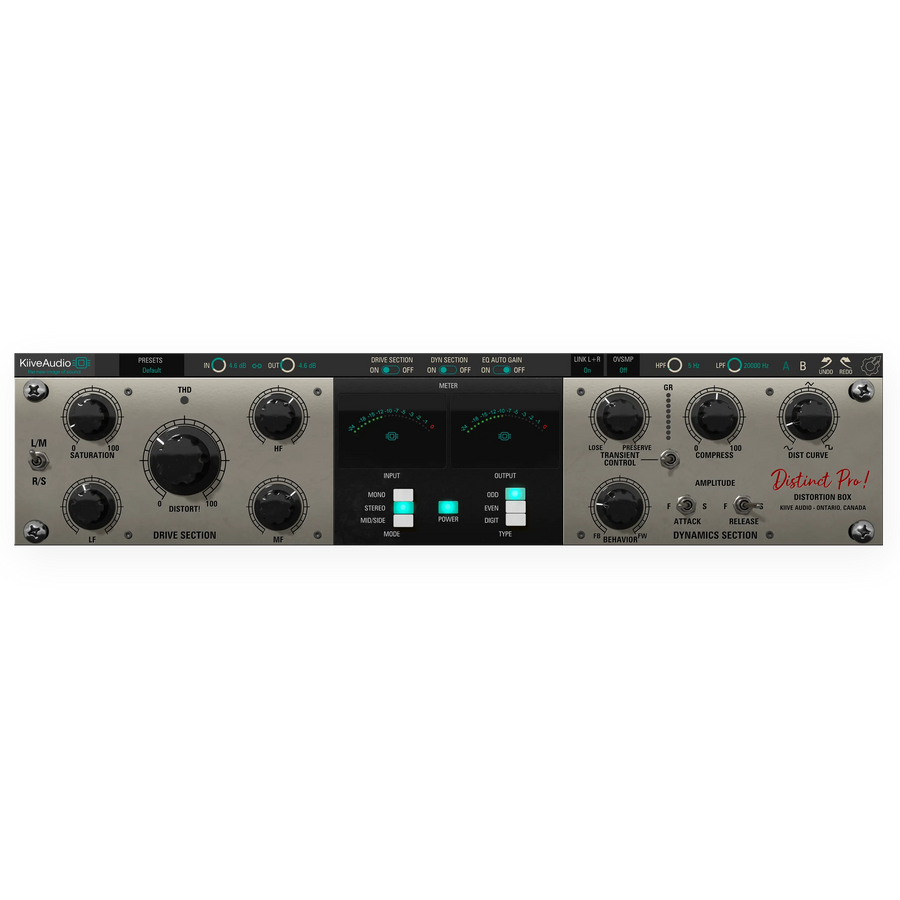
Kiive's Distinct Pro combines multiple saturation circuits with pre/post EQ and detailed dynamics control, so it can move from added density into deliberate distortion while controlling the surrounding envelope. ADC1 separates its compression and limiting modes from an Out mode documented for harmonic saturation, making the distinction between dynamic control and output-stage color especially clear.
Those product connections do not mean every mode is interchangeable. Choose the section that serves the job, then level-match the result before deciding whether the added tone is helping.
Should you clip before limiting?
Clipping before limiting can reduce brief transient peaks before they reach the limiter. That may let the limiter perform less gain reduction and preserve more of the envelope between peaks. The cost is harmonic distortion and permanent waveform change at the clipper.
Try the order on the loudest section, not only on an average passage. Start with a small amount of clipping, reduce the limiter input or threshold to reach the same final loudness, and compare the attack of kick, snare, and vocal consonants. If the clipped version sounds harder, smaller, or more crowded, the limiter was not necessarily the problem.
A limiter before saturation produces a different result. It controls the level entering the nonlinear stage, which can make the saturation more consistent but may remove some of the level-dependent movement you wanted.
A practical level-matched test
Choose a short loop with one or two obvious peaks and enough sustained material to hear tonal changes.
- Set each processor to reduce the highest peaks by a similar amount.
- Match the final output loudness as closely as possible.
- Compare the first few milliseconds of the transient.
- Listen to the body and decay for added harmonics or gain movement.
- Check low frequencies for density, flattening, or modulation.
- Bypass and return at the same monitoring level.
The waveform view can confirm that peaks changed, but the listening test tells you whether the new shape serves the record.
Frequently asked questions
Is saturation the same as clipping?
No. Saturation is a broader family of nonlinear behaviors. It may include soft-clipping-like peak compression, but it can also be frequency-dependent and include hysteresis, memory effects, changing tone, and other system behavior.
Is soft clipping compression?
Soft clipping compresses peak amplitude through a nonlinear curve, but it does not require the detector and attack/release system used by a conventional compressor or limiter.
Does a limiter clip the signal?
A conventional limiter primarily controls peaks through detector-controlled gain reduction. It can distort when pushed, and some designs include clipping or saturation elsewhere in the path, but limiting itself is not simply clipping.
Should I clip before limiting?
It can work when brief peaks cause excessive limiter action. Use a small amount, match final loudness, and listen for added harmonics or flattened transients before deciding.
Related Kiive Learn guides
Explore Kiive Plugins
Want to apply what you learned in your own mixes? Every Kiive plugin includes a fully functional 14-day trial with no card required.